Chauffeur Knowledge

In this world we have two kinds of knowledge, one is Planck knowledge, the people who really know, they paid the dues they have the aptitude.

Then we got chauffeur knowledge, they have learned to prattle the talk. They have a big head of hair, they have a fine temper in the voice, they make a hell of an impression, but in the end they’ve got chauffeur knowledge

– Charlie Munger, 2007 USC Law School Commencement Speech

I found this quote in The Two Types of Knowledge: The Max Planck/Chauffeur Test, which is a great read on the newly (to me) discovered, and seemingly pretty great Farnam Street Blog.

We’ve all met people like this – and speaking from personal experience, it’s infuriating.  I often can’t quite put my finger on why exactly I’m so frustrated – they’re saying the right things generally, but something about it is just not quite right, and it’s being glossed over, hidden, or defensively tossed to the side when poked at as unimportant.

This quote, but further, this article, sheds some light on the problem for me – it’s dishonesty.  Being able to repeat something is not the same thing as knowing it and having the ability to form your own honest opinion or idea about it.

If that’s the case, that’s fine!  Nobody knows everything, and it’s perfectly ok to not know everything, and to acknowledge it and give your opinion based on what you do know (even if all you have is chauffeur knowledge) – but the key is admitting what you don’t know, and being open to what you do.

I know that I’ve slipped into the chauffeur knowledge trap before.  I’d like to not do it again.  Fortunately, Farnam Street (with the help of Ralf Dobelli, author of The Art of Thinking Clearly has this advice:

True experts recognize the limits of what they know and what they do not know. If they find themselves outside their circle of competence, they keep quiet or simply say, “I don’t know.”

Low Touch Parenting

A coworker posted a link to this article on Facebook, which I found pretty interesting:

Low Touch Parenting

As a parent, I often feel inundated with guilt – about exactly how precious my children’s lives are, about what they’re supposed to be doing, what they’re supposed to be able to do, how they should dress, what I should feel, what they should say – everything. And I don’t even get the worst of it – I’m not a person who is necessarily prone to feeling guilty about this sort of thing, and it’s not targeted at me that often.  I feel worse for my wife, and all moms, who deal with a far more powerful onslaught of guilt, judgement, and armchair quarterbacking about who they ought to be, and what their relationship with their kids should be.  I’m consistently amazed at both how powerful “Mom guilt” is, and also how prevalent the ideas and forces that cause it are.

So this article resonates with me.  I love my kids very much.  I want the best for them – both now, in their little tiny lives, and in the future, as they grow up to be adults and maybe have children of their own.  And when I think about what that really means – what “the best for them” is, the best I can come up with is this:

The most important thing I think I can give my kids is permission to live their lives as fully as possible, and the best way I can think to do that is to lead by example.

As if to really accentuate the point, I’m finding it incredibly difficult not to clarify that further – to reassure you of all the things I do, or try to do, to make sure they’re perfect.  But that’s the problem – wanting, needing to show the world just how committed we are to our kids.  So I won’t.  I love them, I want what’s best for them, and that’s what matters.

Dishonest Diplomacy

It was a mistake to speak one’s mind at any time, unless it perfectly matched your political purpose; and it never did. Best to strip all statements of real content, this was a basic law of diplomacy.

Robinson, Kim Stanley. Red Mars (p. 414)

I enjoyed Red Mars well enough, but apparently not so well as to read the sequels.  It was long, and slow in parts.

This quote is good, though.  While it first feels like the author is only talking about actual politics (or maybe political correctness), I think it’s applicable far wider.  How often do we strip statements of real content, and for what reasons?

At the very least, I do it:

  • To avoid offending.
  • To avoid hurt feelings.
  • To avoid looking dumb.
  • To avoid being vulnerable.

Conversely, this kind of shallow, vanilla, no-chance-anyone-could-take-offense discourse is useless.  It’s guaranteed to avoid real connection or understanding.  At best it’s a waste of both parties’ time, at worst it’s one more offending action in a greater pattern of soul crushing, whitewashed dishonesty.

So go say something real, honest, and maybe offensive.  Do it thoughtfully, to an appropriate audience (read:  not facebook), and be ready to listen and discuss why you might be wrong – but do it.

Cinder Cone

Cinder Cone is one of my favorite films on Vimeo, and I find myself coming back to it pretty often.  It’s hard to identify specifically what draws me to it so strongly, but it gets me every time – the music, the camera work, the general vibe, the fact that the project work is defined by seasons – it’s all just so good.

If I had to choose one moment though, it’s this one:

Screen Shot 2017-03-12 at 10.29.43 PM.png

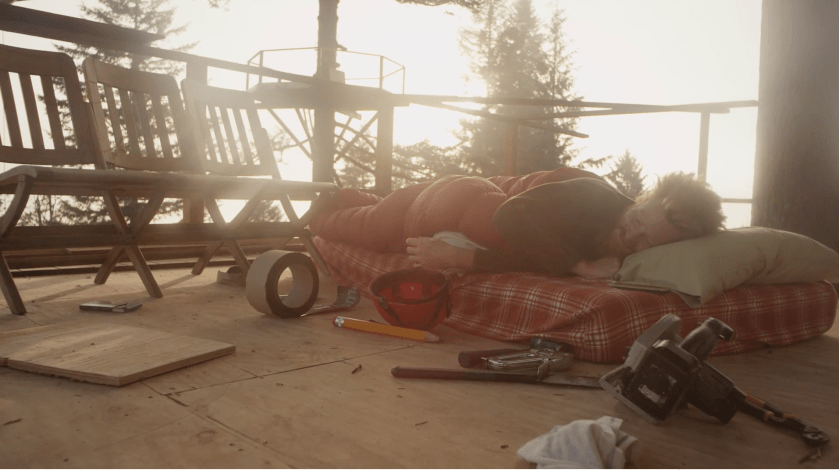
It’s so good, because the moment is so relatable.  He’s so excited about this treehouse (and who could blame him?  The location, the design, everything about it is amazing), he’s going to sleep in it before it’s done.  At first, it just seems like a funny little shot, and maybe that’s all it was intended to be – but it’s so good.  Life should be full of experiences in which you’re so excited about it (whatever it might be) coming together, you’re so excited about the outcome,  that you want to sleep in an unfinished treehouse.  Or you know, whatever the equivalent to “sleep in an unfinished treehouse” is for the thing you’re doing.

Or maybe I actually just want to spend every night in an unfinished treehouse.

What am I going to do today?

It’s Saturday.

I woke up this morning, and rolled over:  7:15.  I get up, go to the bathroom, and come out – directionless.  On a weekday, I’d be headed to the gym, or making the kids breakfast before school – something.  But it’s not a weekday.  I pull up some sweatpants, wander out of the bedroom and into the kitchen.  I look out the kitchen window.  The sun is already up, but the day looks dull and gray.  And I’m faced with the question: “What am I going to do today?”

This is an easy question to avoid on weekdays:  I’m going to work.  What exactly I’m going to do at work is often up in the air – but that’s ok.  I’m working.  I’ll sit down in front of my computer, talk to people, read things, write a post or two, review some code, maybe have a few calls. But no matter what I do, I’m safe from the dreaded question “What am I going to do today?” – I’m going to work, and work is safe.  Unquestionable.  I have to work to pay for this house, food for my kids, life.  So there’s no decision.  I work.  5 or 6 rolls around, and I can go relax with the kids, have some dinner, maybe go for a run or watch TV.  It’s all safe, because I’ve already done what I’m supposed to that day, so now I can indulge, without pesky questions about how I’m spending my time.

But that’s not today.  Today as a weekend, and in theory, I’m not working.  So I have to make decisions.

On it’s face, “What am I going to do today” is not so hard – I can do any number of things, and I have a lot of ideas:  I can sit around the house and read.  I can play video games (with or without the kids).  I can exercise.  I can plan a trip with the family – maybe a drive to the mountains, or to the trampoline park for the kids.  I can cook – maybe it would be nice to have a couple of loaves of homemade bread this week?  I can clean the garage, or do yardwork.  I can build furniture, or start on some other creative project.

But it turns out the difficulty of the question is not about the actual actions I’m going to take – the feeling of dread that comes with it is not about a lack of options, or impending boredom.  The issue, the real question, comes later: “Am I satisfied with what I did today?”  Especially on a weekend: if you accept “workdays” as free from this kind of personal scrutiny (which is an idea that deserves more thought and a separate blog post), then the weekends are particularly important – the 2 days out of 7 that you get to choose entirely how your time is spent.  What are we, if not how we spend our free time, without constraints, without direction or duties to hide behind?

Is it ok to sit and watch TV all day?

Cleaning is safe, right?  Nobody can question if the guy cleaning his garage is using his limited time wisely.  Right?

I don’t have an answers here, this isn’t that kind of post.  What I think I know is this:  a day that does not that move you meaningfully toward your goals, or fulfill you in some way, is wasted.  And we only get so many.

Anatomy of a bad decision

Once upon a time, I was making a long drive home. The drive was from my brother’s house, in central Utah, to my house, in Northeastern Colorado. If you’ve not made this particular drive before, I’ll fill you in on the important bits:  It’s long, boring, and almost entirely spent in Southern Wyoming.

Don’t get me wrong, Wyoming has some great stuff in it: Yellowstone, the Grand Tetons, the setting for “Brokeback Mountain”.  Southern Wyoming, however, really just has Tree in the Rock:
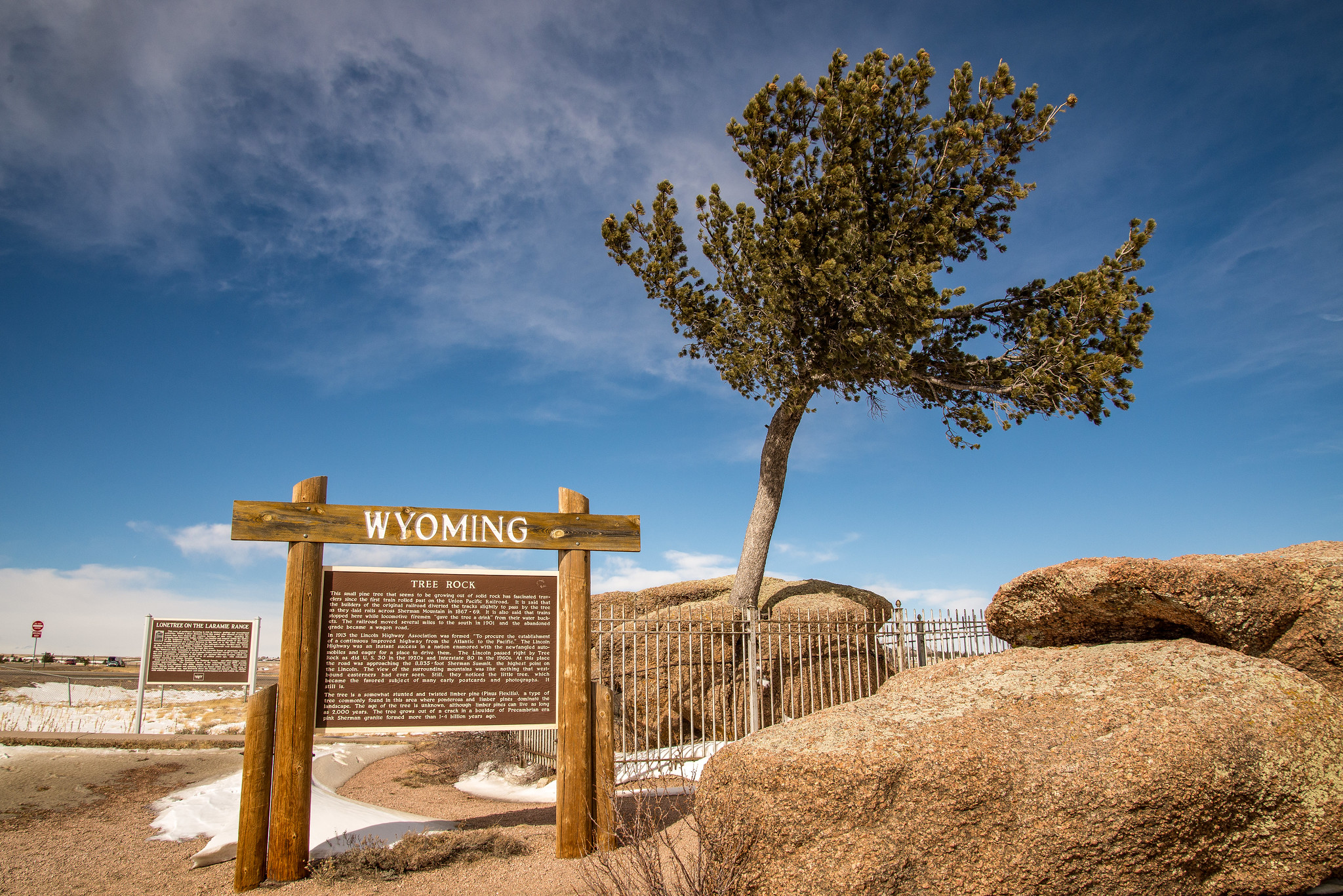
Tree Rock

I made a lot of trips as a child across this road to visit my grandparents, and as I recall, this tree is really it – the most exciting thing I-80 has to offer.  It’s generally brown, monotonous, and most importantly, eternally windy. It’s the kind of place you just want to drive fast through.

As I recall, it was right around this time of year – maybe late February or early March. I was driving alone, and the weather was nasty – snowing pretty heavily, with very icy roads. On the way out of Utah, I watched multiple cars slide off the road. Once I got out of the mountains of Utah and headed into the plains of Wyoming, the weather seemed to let up a bit – not much snow on the roads, and even a peek of blue sky now and again.

So I sped up.  I was making great time, when I saw a road sign: “Highway Closed at Rock Springs”. Sure enough, I get to Rock springs a few minutes later, and the highway is blocked, all traffic being diverted into town. Immediately, I’m annoyed. I don’t want to be on this road any longer. I’ve been away for a week, and the idea that I’ll have to wait a few more hours (at best) in Wyoming, of all places, is unthinkable.

So, I made a good decision: I stopped, and ate a burrito. It was tasty.

Burrito consumed, I got back in the car and checked the radio: Highway still closed.  It’s been maybe an hour. So I figure I’ll do a little investigating. How closed is closed, anyway? Maybe I can get around it.

Impatience

So I start poking. I try a frontage road, which, in case you call it something else colloquially, is the much smaller road next to the highway. I drive a little way down, and there it is – a state trooper parked sideways across the road. He flags me down and motions for me to turn around. I ask if he has any idea how long it will be. Clearly annoyed, he condescendingly tells me “Son, just head on back to town. It will be open when it’s open.”

I’ve had various problems with authority in my life, and I don’t take kindly to condescension – from a Wyoming State Trooper of all people. This man has just made my decision for me: I will find a way around this road closure.

Hubris

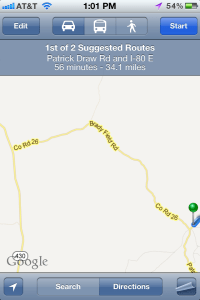
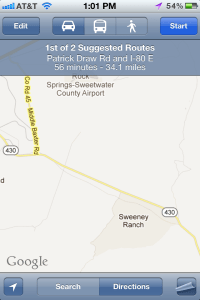
So I head to a Mcdonalds, and use the wifi to pull up a map of the area. (Side note: At the time, this area of Wyoming did not have 3g service. I had no internet.  This should have given me pause.). I find a route that seems promising. it’s pretty far out of the way, but it should definitely get around wherever the closure is. Knowing I won’t have internet once I leave the warm glow of this McDonalds, I take this series of screenshots:

As you can see, my plan is foolproof.

So I head out. After a few misses, I find my first turn. I distinctly remember thinking it  was a little weird that I had so much trouble finding the turn, and that this road was so poorly marked. It looked like the road I needed to turn onto was not plowed, which also seemed a little strange. I put my blinker on, and slowed down. For a brief moment, I considered just heading back to Rock springs.

I turned onto the road. It was clearly unplowed, but that was ok – there were some tracks through it. The road felt a little strange under the wheels, and it took me a bit to figure out why.  Soon I realized: Oh – this seems bumpy because this is a dirt road. I didn’t notice because it’s covered in snow.  This was not part of the plan.  I carried on

Commitment

As I drove on, the snow on the road started getting deeper. What started as wide, messy tracks slowly transitioned into deep, well defined ruts in the snow.  But I was ok – I’d driven in the snow lots of times before.  It was fun!

Then something strange happened: I started getting little blasts of snow blowing up over the windshield.  I couldnt figure out what was going on at first – was the wind blowing?  Is it gusty?  It happened with increasing frequency until snow was flowing over the windshield in a steady stream, making it hard to see.  That’s when I realized what was really happening – the snow was deep enough that it was billowing up over the bumper, and over the windshield.

At this point I realize that I should probably be concerned.  This isn’t going well.  Still, I drove on.  Because – what if I’m just about to hit the next road – plowed and dry?  Won’t I feel silly for almost having turned around!

As I’m having this thought, I head around around a bend.  The road becomes sloped down to the left. I can’t keep my tires in the ruts, and in spite of steering and frantic yelling, the car starts to slide toward the ditch at the bottom of the slope. I know if I end up in the ditch, I won’t escape without a tow truck. So I stop the car.

Acceptance

The car stopped. It was mid afternoon, and I knew it would be dark in a couple of hours. I was on an dirt road, covered in close to a foot of snow, and I was probably 25 miles from the closest city. The gravity of the situation was setting in. Getting to this point involved a number of poor decisions, but those were irrelevant now.

I decided I needed to get the car turned around.

Decision

Of course, this might not have been the right decision. I didn’t know how far the road ahead was. I didn’t know what the conditions ahead were. It might have been smarter to keep driving forward, or just start walking and abandon the car, or just hang out in the car with the heater on and wait for someone to come along. I didn’t know for sure – but in that particular moment, I committed to the decision to turn around.  I knew if I thought about it too long, I’d second guess myself – so as soon as the car stopped, I was out the door, figuring out what I was going to do.

My plan was to clear the snow from a large portion of the road so that I could turn around on dirt, not snow, and avoid sliding down into the ditch.  I’ll do it  Austin Powers style – lots of back and forth.

So I dove in, working frantically, to keep my mind from spending too much time thinking of how this could go wrong. Get down on my hands and knees, push a bunch of snow out of the way, hop into the car, move it a foot.  Hop out, push some snow, hop in, move it another foot.

Help!

I had the car a little over halfway turned around and I look up, and to my surprise, see a rowdy pickup truck coming through the snow. I look up, and lock eyes with the driver. I’m in the middle of nowhere, down on my knees, in wet jeans, pushing snow around on a dirt road with my hands – not unlike a child in a sandbox –  next to a 15 year old Honda Civic.

There is an iMac in the backseat. It’s wearing a seatbelt. My shame is palpable.

I knew I had to ask for help – but to do so meant acknowledging my situation and the decisions I had made that got me there. Terrible decisions that I didn’t want to have to justify to anyone. He rolled the window down, and offered to push my car back into the middle of the road, because he didn’t have a tow rope. I was appreciative, although the plan of essentially ramming my poor little civic down the road was not my favorite.  Still, what could I do?

He attempted to drive around the back of my car (ramming position), but getting there was tricky because of the snow and the slope.  He managed to slide his truck into the ditch, and had to spend some time figuring out how to get out of it.

In the meantime, I kept working. I had the car pointed mostly in the right direction, so I cleared 20 foot “runway” in front of it that I could use to pick up speed before I had to get back into the snow. I hopped in my car, signaled to them that I was going for it, and took off, shouting “thank you!” out the window.

A few seconds later, I was back in the ruts, and headed back towards town. I had made it.  I’m not sure what happened to them, but I like to think that at the very least, they had a pretty funny story  when they got to their destination.

I slowly made it back to Rock Springs – beaten, but alive. I pulled into that same Mcdonalds – the one where my plan was originally hatched.  I went inside, ordered a milkshake, and sat down – willing to stay there for hours – days even – until that condescending state trooper told me it was all clear.
Bushy

I just want us all to imagine how this day went:

It’s a Tuesday.

You wake up in the morning.  You’re in Alaska.  You’re a pro skier, but it’s summer time, so you’re doing whatever pro skiers do in the summer (Not sure what that is?  Buckle up.).

You get up, have some breakfast, give some thought to what you might do today.  Soon enough, you round up the crew, and head out to your plane.  Because you also have a pilot’s license, and a plane, I guess.  Why wouldn’t you?

So you take off, in your plane.  Where are you going?  Literally wherever you want.  Today, “wherever you want” seems to be up a river somewhere.  Why a river?  Because it’s beautiful, and while you’re there, you want to skim your wheels on it.  And, having done this before, and everyone having agreed that this is possibly the coolest thing that anyone has ever done, and they’re going to go ahead and follow you in a helicopter while you do it, to get it on film.

And then while the wheels are on the water, you accidentally hit the smoke briefly.  Because the smoke button is right next to the stick.  Or steering wheel. I don’t know, I’ve never flown a plane.

It’s a Tuesday.


Author’s note: I actually have no idea what day of the week this was filmed on. I’m sorry.

When We Were Knights

You either live a genuine life that’s true to who you are, or you don’t.

✔️ Wingsuit POV footage
✔️ Spectacular landscape photography
✔️ Quotable dialog
✔️ Atmospheric soundtrack
✔️ Hijinks
✔️ Tearjerking story that makes you want to get out and live

There’s really no reality, no scenario where I don’t love this film.  I’ve probably watched it 10 times. I’ll probably watch it 10 more.

The more surely the future is known, the less surprise and the less fun in living it

When the outcome of a game is certain, we call it quits and begin another. This is why many people object to having their fortunes told: not that fortunetelling is mere superstition or that the predictions would be horrible, but simply that the more surely the future is known, the less surprise and the less fun in living it.

Watts, Alan W.The Book: On the Taboo Against Knowing Who You Are

This book, (and maybe Alan Watts in general), is completely nuts.  Way out there, much further gone than I can really stomach very easily.  I’m not sure I can finish it.  Even so, it’s sprinkled with all these little nuggets which, when removed from the greater context that he’s providing them in, are pretty great.

The Shooter and the Farmer

When the members of the Frontiers of Science discussed physics, they often used the abbreviation “SF.” They didn’t mean “science fiction,” but the two words “shooter” and “farmer.” This was a reference to two hypotheses, both involving the fundamental nature of the laws of the universe.

In the shooter hypothesis, a good marksman shoots at a target, creating a hole every ten centimeters. Now suppose the surface of the target is inhabited by intelligent, two-dimensional creatures. Their scientists, after observing the universe, discover a great law: “There exists a hole in the universe every ten centimeters.” They have mistaken the result of the marksman’s momentary whim for an unalterable law of the universe.

The farmer hypothesis, on the other hand, has the flavor of a horror story: Every morning on a turkey farm, the farmer comes to feed the turkeys. A scientist turkey, having observed this pattern to hold without change for almost a year, makes the following discovery: “Every morning at eleven, food arrives.” On the morning of Thanksgiving, the scientist announces this law to the other turkeys. But that morning at eleven, food doesn’t arrive; instead, the farmer comes and kills the entire flock.

Liu, Cixin | The Three-Body Problem (Remembrance of Earth’s Past)

I enjoyed this book quite a bit, but this was by far the most interesting proposition to me.

What do we really know?  What can we really know?